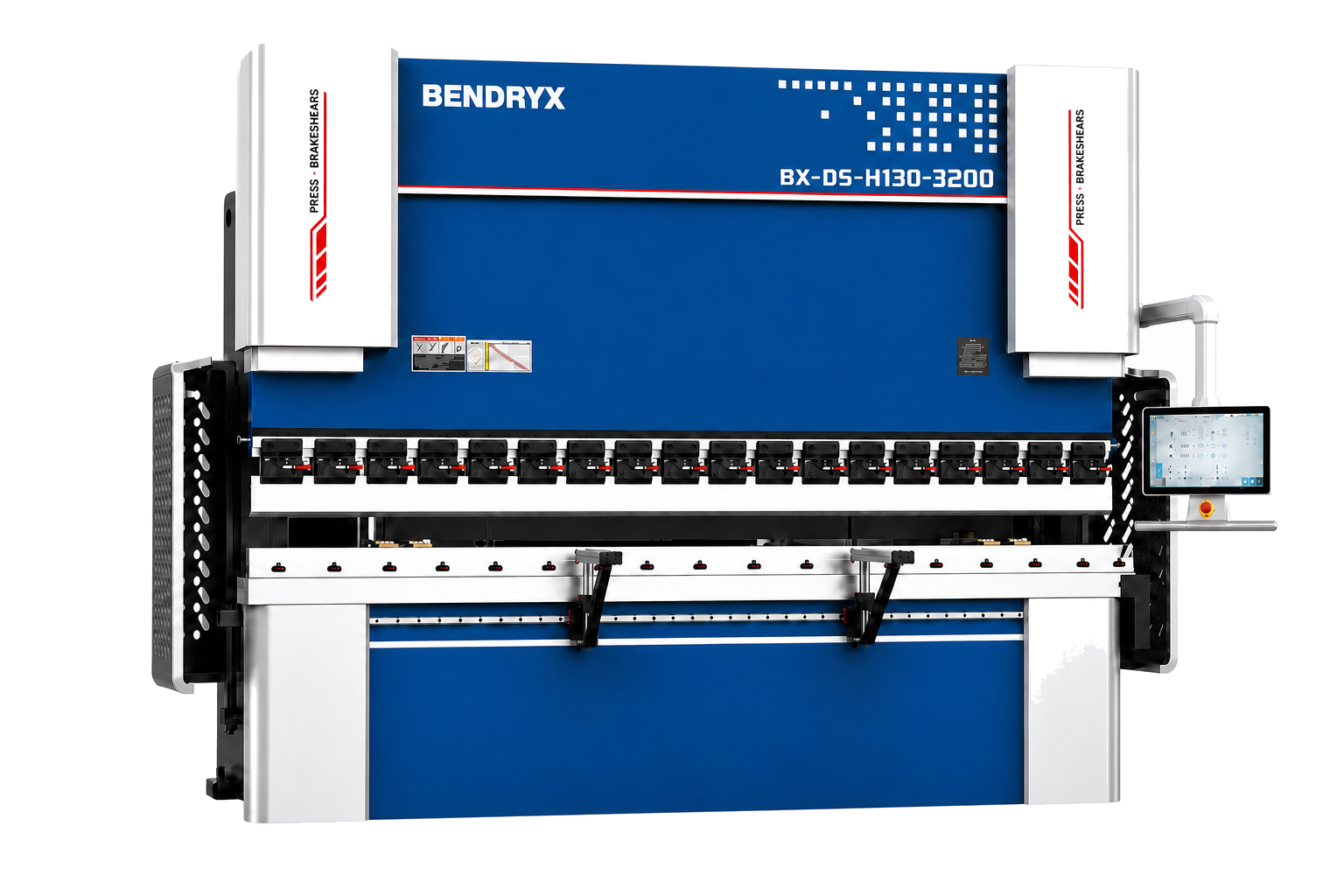
The word “hybrid” is used broadly in press-brake marketing. It does not describe one universal mechanism. Always confirm the number of servo motor-pump units, hydraulic layout, oil volume, ram synchronization method and rated machine performance.
The simple definition.
A conventional hydraulic press brake commonly runs an electric motor and hydraulic pump continuously, then meters oil through valves to move and synchronize the ram. A servo-hydraulic hybrid instead uses a variable-speed servo motor to control a hydraulic pump according to the movement required at that moment.
The servo does not replace the hydraulic cylinders. It controls how hydraulic pressure and flow are produced. This is why a hybrid can retain high forming force while reducing unnecessary pump operation during idle and low-demand portions of the cycle.
How a hybrid bending cycle works.
Exact oil paths and control strategies vary by manufacturer. The practical principle is consistent: motor speed and torque become control variables for delivering hydraulic power only where the cycle needs it.
How hybrid differs from hydraulic and electric.
| Architecture | How ram force is created | Typical strength | Key consideration |
|---|---|---|---|
| Conventional hydraulic | Electric motor, hydraulic pump, valves and cylinders | Established high-force architecture with broad service familiarity | A constant-running power unit can create more idle energy, heat and noise |
| Servo-hydraulic hybrid | Variable-speed servo motor-pump system and hydraulic cylinders | Hydraulic force with demand-based control, strong response and broad tonnage range | Still contains hydraulic oil and requires application-specific system design |
| Full electric | Servo motors and mechanical transmission such as ball screws | Clean, responsive motion without hydraulic oil in the bending drive | Machine size, force range and load distribution must fit the application |
Hybrid is not automatically “better” for every shop. A compact electric machine may be the simpler fit for small precision parts. A conventional hydraulic or engineered heavy-duty system may be appropriate for unusual force, length or custom forming requirements.
Single, dual and adaptive hybrid are not the same.
Single-servo hybrid
One coordinated servo-hydraulic power architecture serves the bending system. It is a practical, versatile starting point across mixed fabrication work.
Dual-servo hybrid
Two servo-driven hydraulic power channels support responsive left-right ram control and production-oriented performance across broader machine capacities.
Adaptive servo hybrid
The servo-hydraulic drive is paired with an architecture focused on controlling deflection and bend consistency across demanding parts and working lengths.
The number of servos alone does not determine finished-part accuracy. Frame rigidity, cylinder feedback, crowning, tooling condition, material variation, CNC programming, backgauge positioning and operator process all contribute.
Which architecture fits your work?
- Start with E-Series for compact precision parts, clean operation and lower-force electric bending.
- Start with SS-Series for broad day-to-day fabrication and changing part requirements.
- Start with DS-Series for higher utilization, responsive production and broader capacity needs.
- Consider AS-Series when bend straightness, structural rigidity and compensation are central to the application.
- Move to ST or X-Series for very long components, tandem operation or engineered heavy-duty force.
Technical source notes
This guide explains general drive principles rather than promising a universal percentage improvement. Actual energy use, speed, oil volume and maintenance depend on machine size, duty cycle and final configuration.