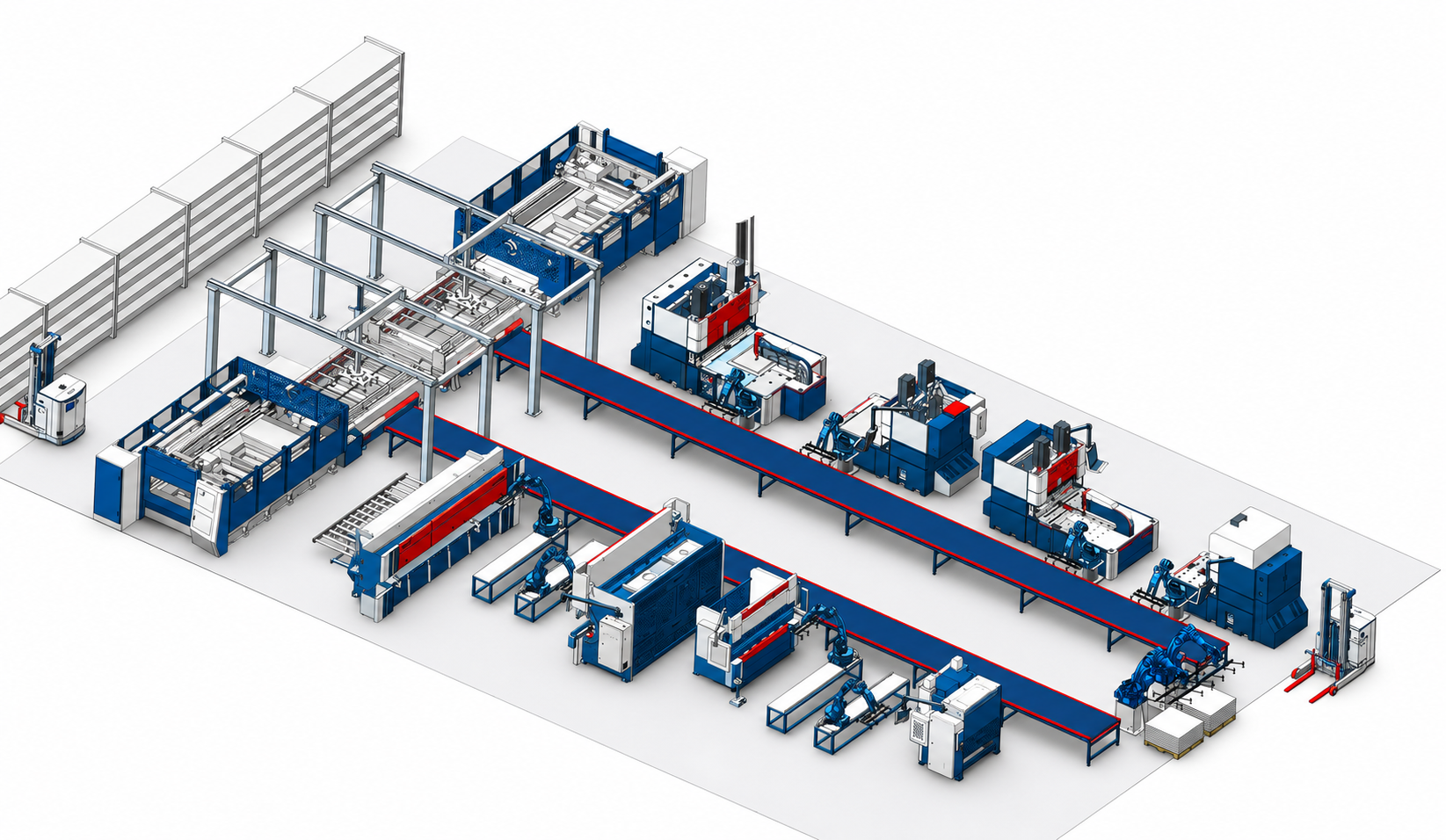
A press brake can repeat its programmed position accurately while still producing inconsistent parts if the blanks vary. Coordinating cutting and bending as one process reduces avoidable correction.
Control blank dimensions and edge condition.
Flange dimensions are established from the cut edge or feature used against the backgauge. Dimensional variation, heavy burrs, dross or distortion change the physical datum and can shift the finished flange.
Design stable gauging datums.
Whenever possible, provide straight, accessible edges that sit reliably against the gauge fingers. Small tabs, curved edges and flexible narrow sections can require custom fingers or alternate bend sequencing.
Keep material and part identity connected.
Correct programs depend on material grade, thickness and tooling. Part marking, job travelers or digital tracking reduce the chance of applying the right program to the wrong blank.
Plan the physical flow between machines.
Nesting, unloading, sorting, deburring and staging affect whether the press brake receives parts in a predictable sequence. Automation can connect these steps, but organized manual flow often delivers meaningful gains first.
Connect cutting, bending, tooling and support.
Fiber laser cutting systems and upstream blank production.
Application-matched press brakes, CNC and gauging.
Tooling, adapters, clamps and workholding support.
BENDRYX connects the application review, equipment selection, installation planning, parts and North American service support.
Plan a connected production system →